 AL NOOR BUILDING - Office No: 506 - Damascus Street - Al Qusais -Al Qusais Ind. Third - Dubai, UAE
 +971 429 49 139
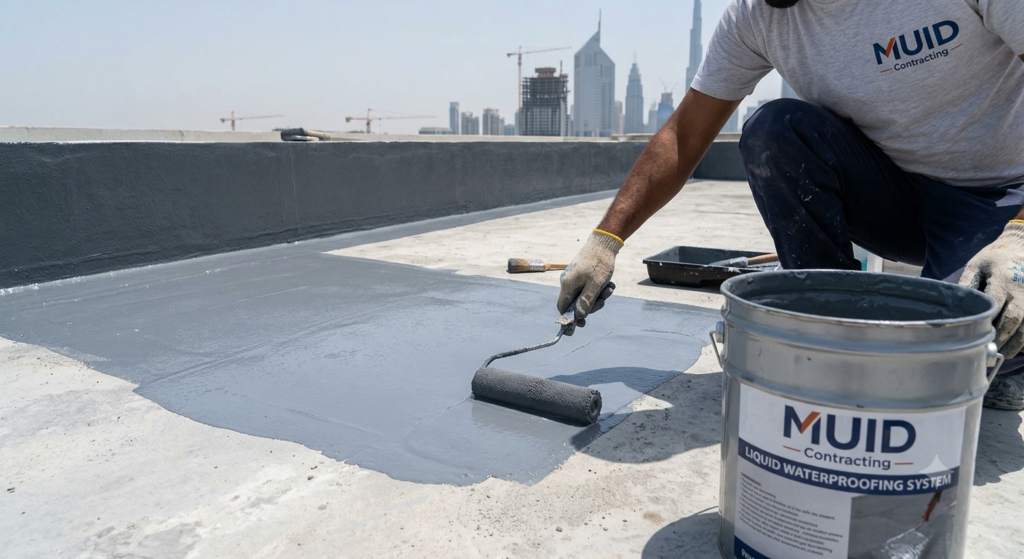
In the United Arab Emirates, the architectural landscape is a marvel of modern
engineering, boasting soaring skyscrapers, luxurious coastal developments, and
expansive urban hubs. However, beneath the polished glass and concrete lies a
silent, structural battle. While the UAE is renowned for its arid climate,
waterproofing failure remains one of the most prevalent and costly challenges in the
region’s construction sector.
When water penetrates a building’s envelope in this region, it doesn’t just cause aesthetic ruin—it
triggers rapid structural decay due to high ambient salinity and extreme thermal dynamics.
Understanding why these systems fail is vital for developers, facility managers, and contractors
looking to protect their assets from costly remediation.
- Extreme Thermal Expansion and Contraction
The Arabian Gulf experiences some of the highest ambient temperatures in the world, with
summer highs frequently crossing 45°C, while roof surface temperatures can spike well above
70°C. Conversely, night temperatures drop significantly, creating an intense, daily thermal cycle.
This constant fluctuation causes concrete structures to expand and contract aggressively. If the
specified waterproofing membrane lacks sufficient elasticity or high elongation properties, it
brittle-fractures or splits under the sheer mechanical stress of the moving concrete substrate.
Over time, these micro-fissures allow moisture to seep in during high-humidity periods or rare
but intense seasonal downpours.
PRIMARY FAILURE VECTOR: THERMAL STRESS
Using cheap, low-elasticity bitumen membranes on expansive roof decks without factoring in thermal
movement. The system shears at the joints and structural expansion gaps.
Solution: High-elongation Polyurethane or Polyurea liquid membranes.
1
- Substrate Hydrostatic Pressure and High Groundwater Tables
In coastal regions like Dubai Marina, Jumeirah, and coastal parts of Sharjah, the water table is
exceptionally high and highly saline. Basements, underground parking structures, and lift pits
are constantly submerged in groundwater.
Waterproofing failure in these substructures typically happens when systems are only designed
to repel gravity-fed water rather than resisting continuous, positive or negative hydrostatic
pressure. When groundwater presses against a poorly sealed basement raft or retaining wall, it
finds the path of least resistance—usually cold construction joints, honeycombed concrete, or
pipe penetrations. - Blistering Caused by High Humidity and Trapped Moisture
The UAE experiences intense relative humidity during summer months, often exceeding 90%.
When contractors apply liquid-applied membranes or torch-on sheets onto concrete that has not
fully cured or is damp from ambient humidity, moisture becomes trapped underneath the
waterproof barrier.
As the sun beats down on the surface the following day, this trapped water heats up, vaporizes,
and expands. Unable to escape, the vapor pressure forces the membrane away from the
substrate, creating large bubbles or “blisters.” Once a membrane blisters, it loses its adhesion,
becomes brittle, and eventually punctures under foot traffic or structural shifting.
PRIMARY FAILURE VECTOR: POOR MOISTURE TESTING
Rushing the waterproofing application during fast-track project timelines without verifying the
concrete substrate’s moisture vapor emission rate (MVER).
Solution: Mandatory relative humidity probe testing and moisture barriers.
- Severe Chemical Aggression (Salinity and Chlorides)
Groundwater in the UAE isn’t just water; it is a aggressive chemical cocktail rich in chlorides and
sulfates. When external waterproofing fails, this saline water contacts the reinforcement steel
inside the concrete.
The chlorides accelerate electrochemical corrosion, causing the rebar to rust and expand up to
several times its original volume. This creates internal pressure, leading to concrete spalling,
cracking, and a rapid acceleration of water ingress. A failure in waterproofing here directly
equates to a compromise in the structural integrity of the entire building skeleton.
2
- Poor Detailing Around Critical Penetrations
Statistically, over 80% of all waterproofing leaks occur at less than 1% of the building’s total
surface area. These critical points include roof drains, pipe penetrations, mechanical equipment
plinths, and structural expansion joints.
In many UAE projects, failures happen because standard membranes are simply rolled over or
slapped around these complex geometries without proper termination bars, counter-flashings, or
specialized sealant detailing. Overlooking fillets (smoothing out 90-degree internal corners) is
another common mistake that causes membranes to stretch thin and crack at wall-to-floor
junctions.
The Path Forward: Prevention Over Remediation
Remedial waterproofing in an operational building in downtown Dubai or Sharjah can cost up to
five to ten times the original installation price, involving extensive excavation, business
disruption, and structural repairs.
To mitigate these failures, the UAE construction market is steadily shifting toward high-
performance, weather-resilient technologies such as cold liquid-applied polyurethanes,
crystalline waterproofing admixtures that self-heal concrete cracks, and robust quality control
protocols during the application phase. In an environment as unforgiving as the Gulf, meticulous
application and uncompromising material selection are the only true shields against water
damage.