 AL NOOR BUILDING - Office No: 506 - Damascus Street - Al Qusais -Al Qusais Ind. Third - Dubai, UAE
 +971 429 49 139
Waterproofing is often described as the invisible shield of a structure. While it typically accounts for less than
3% of a building’s total construction cost, its failure is responsible for over 80% of all building defect
complaints and subsequent litigation. When water manages to breach a building envelope, the consequences
are progressive, destructive, and financially devastating.
Waterproofing failures almost universally stem from two core deficiencies: substandard material selection
and poor workmanship. This technical brief analyzes how these two factors interact to undermine structural
integrity, erode property value, and create severe health liabilities for occupants.
- The Pitfalls of Substandard Materials
In an effort to trim immediate procurement costs, contractors frequently opt for lower-grade or mismatched
waterproofing compounds. However, generic or sub-par membranes rarely possess the chemical stability
required to survive subgrade environments, UV exposure, or structural movement.
Inadequate Elasticity and Elongation Properties
Every building undergoes minor thermal expansion, contraction, and structural settling. High-quality
waterproofing membranes are engineered with high elongation percentages to stretch across minor cracks.
Cheap, uncertified materials lack this elasticity; under structural stress, they brittle, shear, and tear, instantly
opening an unhindered path for water entry.
Poor UV Resistance and Premature Aging
Exposed systems, such as roof and balcony coatings, must endure intense ultraviolet (UV) radiation and
fluctuating ambient temperatures. Low-tier acrylics or substandard liquid membranes degrade rapidly under
solar exposure, turning brittle, cracking, and chalking away within a fraction of their promised operational
lifespans.
Chemical Incompatibility
A waterproofing system is only as strong as its chemical synergy with substrates and adjacent adhesives.
Substandard membranes often react poorly to the alkaline nature of fresh concrete or fail to bond properly
with joint sealants, leading to delamination—where the membrane detaches from the surface it is meant to
protect.
Building Sciences & Construction Quality Report 1
Engineering Rule of Thumb: Liquid-applied membranes must never be purchased based on price per
bucket. They must be selected strictly on solid content volume, crack-bridging capability, and third-party
performance certifications (such as ASTM or British Standards).
- The Crisis of Poor Workmanship
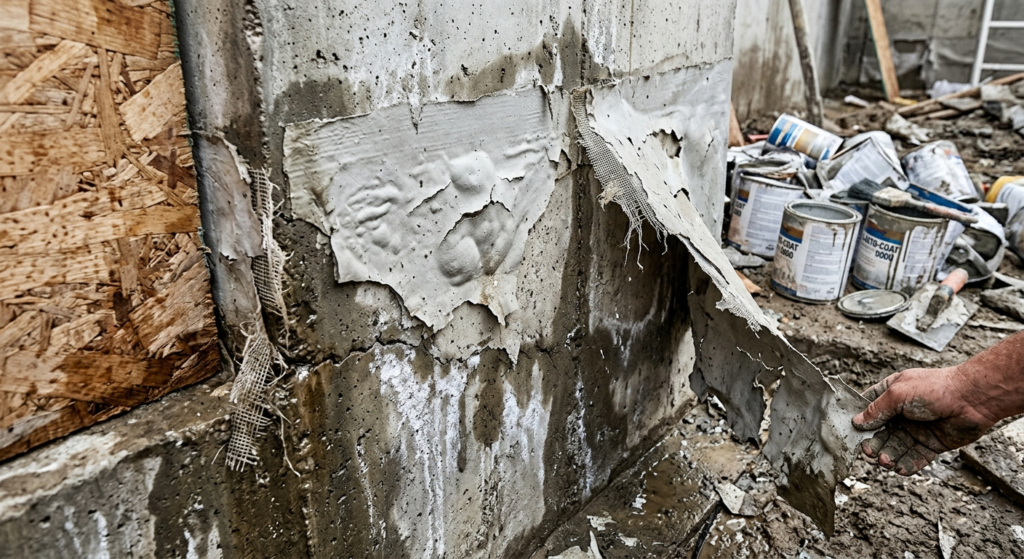
Even the most advanced, military-grade waterproofing system will fail if applied incorrectly. Workmanship
errors remain the leading driver of premature moisture intrusion, usually caused by untrained labor, rushed
schedules, or a lack of supervisory oversight.
| Workmanship Error | Technical Consequence | Prevention Protocol |
| Neglected Surface Preparation | Membranes applied over dust, oil, moisture, or honeycombed concrete fail to form a mechanical bond, leading to immediate delamination and blistering. | Substrates must be clean, dry, sound, and mechanically abraded or primed prior to installation. |
| Incorrect Wet Film Thickness (WFT) | Applying liquid membranes too thin results in pinholes and insufficient tensile strength. Applying too thick causes mud- cracking during curing. | Mandatory use of notched mil gauges during application to ensure precise compliance with technical datasheets. |
| Improper Lap Joint Detailing | Sheet membranes (like torch-on bitumen or PVC) fail at the seams if overlaps are insufficient or inadequately bonded/ welded. | Maintain a minimum 75mm to 100mm overlap, verified via physical seam-testing probes. |
| Omission of Fillets / Cants | Applying membranes directly into a sharp 90-degree internal corner causes stress concentrations, leading to tearing. | Install a 50mm x 50mm mortar fillet (chamfer) at all wall-to- floor junctions before waterproofing. |
- The Downstream Cascades of Failure
When bad materials meet careless execution, the results are rarely confined to a simple damp spot on a wall.
The destruction manifests across three primary vectors:
Structural Corrosion (Concrete Cancer)
Moisture infiltrating reinforced concrete triggers carbonation and introduces chlorides. This leads to the
oxidation (rusting) of embedded steel rebars. As steel rusts, it expands up to ten times its original volume,
Building Sciences & Construction Quality Report 2
cracking the surrounding concrete from within. This structural spalling drastically compromises the load-
bearing safety of slabs, beams, and columns.
Toxic Mold Growth & Indoor Air Quality (IAQ) Degradation
Persistent moisture behind drywall, under flooring, or within ceiling cavities creates an ideal breeding ground
for toxic molds like Stachybotrys chartarum. Spores released into the indoor HVAC stream cause severe
respiratory issues, asthma flare-ups, and chronic allergic reactions among inhabitants.
Catastrophic Financial Liability
Remediating a failed waterproofing system retroactively is vastly more expensive than doing it right during
initial construction. It involves breaking up finished tiles, excavating retaining walls, demolishing architectural
finishes, reapplying membranes, and rebuilding the space—frequently costing 5 to 10 times the original
waterproofing budget, alongside loss of use or tenant displacement penalties.
Conclusion: Prioritizing Quality Assurance
Waterproofing is not a place to seek budget optimizations. Protecting a structure from fluid ingress
requires an uncompromising commitment to premium, certified materials and certified, highly-skilled
labor. Ensure that comprehensive surface preparation is enforced, mandatory flood testing (minimum
24 to 48 hours) is conducted on all wet areas, and detailed quality checklists are executed at every
stage of the build.
Investing in quality materials and skilled craftsmanship is the only dependable method to safeguard
your asset, protect structural integrity, and ensure long-term peace of mind.